Market Problem
Freight transportation remains fragmented. Capacity discovery (load boards), execution (TMS), and visibility (tracking) are often delivered by separate vendors with limited interoperability. This fragmentation causes inefficiencies, higher costs, and poor real-time decision-making.
Solution Overview
A unified transport platform built around:
- An API-first load marketplace
- A modular Transportation Management System
- Real-time geolocation and mapping services
By consolidating these layers into a single ecosystem, the platform enables seamless freight matching, execution, and visibility with minimal manual intervention.
Why This Matters
- Network effects: More shippers attract more carriers, increasing liquidity.
- Data advantage: Real-time location and historical movement data enable predictive insights.
- High switching costs: Deep API integration makes the platform sticky.
- Scalability: Cloud-native, multi-tenant architecture supports rapid geographic expansion.
Monetization Opportunities
- Transaction fees per load
- SaaS subscriptions for TMS modules
- Premium API access (tracking, pricing intelligence, optimization)
- Value-added services (instant pay, insurance, compliance)
Strategic Edge
The real-time geolocation layer is not an add-on - It is foundational. This enables advanced ETA prediction, dynamic pricing, and automation that competitors relying on static data cannot easily replicate.
2. Developer-Focused Perspective
API-First Architecture
The platform is designed as a set of loosely coupled services, all exposed through well-documented REST and WebSocket APIs.
Core API domains include:
Load Board API
- Create, update, and publish loads
- Search and filter available capacity
- Bid, accept, and award loads
TMS API
- Shipment lifecycle management
- Carrier assignment and dispatch
- Rate, contract, and document management
Geolocation & Maps API
- Real-time GPS ingestion
- Reverse geocoding
- Route calculation and ETA prediction
- Geofencing events (arrival, departure, delay)
Real-Time Data Flow
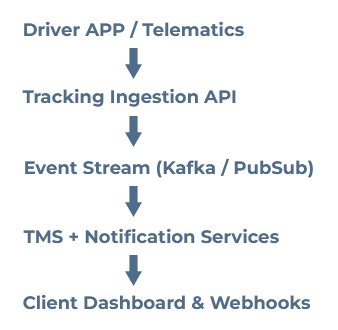
- WebSockets or server-sent events provide live map updates
- Webhooks notify external systems of shipment milestones
- Idempotent endpoints ensure safe retries
System Architecture Highlights
- Microservices with clear bounded contexts
- Stateless APIs with token-based authentication
- Horizontal scaling for peak load-board traffic
- Spatial indexes for fast geolocation queries
- Map rendering abstracted to support multiple providers
Developer Benefits
- Easy integration with ERP, WMS, accounting, and mobile apps
- Clean separation between business logic and visualization
- Ability to embed maps, tracking, and booking directly into third-party platforms
3. End-User Perspective (Shippers, Brokers, Carriers)
Real-Time Maps as the Core Experience
Users don’t interact with “systems” - they interact with maps.
The platform provides:
- Live vehicle locations on interactive maps
- Accurate ETAs that update automatically
- Visual alerts for delays, detours, or dwell time
- Automatic status changes via geofencing
This removes the need for manual check calls and constant follow-ups.
Load Board Experience
- Smart load recommendations based on location and history
- Nearby loads highlighted directly on the map
- One-click booking or bidding
- Transparent pricing and lane intelligence
TMS Automation
- Loads flow automatically from planning to execution
- Tracking is enabled by default upon dispatch
- Documents and invoices are generated from events
- Customers receive live tracking links without extra effort
Operational Impact
- Fewer phone calls and emails
- Faster load coverage
- Reduced empty miles
- Higher on-time performance
- Greater trust through transparency
4. How It All Connects (System-Level View)
At a system level, the platform acts as a real-time orchestration layer:
- The TMS defines intent (what needs to move)
- The load board provides liquidity (who will move it)
- The geolocation engine confirms reality (what is actually happening)
APIs ensure that every event-booking, pickup, movement, delivery-is captured once and reused everywhere.
5. Future-Proof Design
The architecture is designed to support:
- AI-driven load matching
- Predictive ETAs and risk scoring
- Dynamic pricing based on live capacity
- Autonomous decision workflows
- Third-party ecosystem extensions via APIs
Real-time maps evolve from visualization tools into decision engines.
Summary
This platform is not just software - it is infrastructure for modern freight.
- Investors gain a scalable, data-rich marketplace with strong defensibility
- Developers get clean APIs, real-time streams, and extensible architecture
- End users get clarity, speed, and confidence through live maps and automation